
I remember standing in the back of my gallery in 1998, staring at a collection of landscape oils that were technically proficient but utterly soul-crushing, while a local developer asked me if I knew “how to curate a small exhibition” that wouldn’t make his wife bored. He didn’t want art; he wanted atmosphere. Most people think curation is about being a tastemaker or having a PhD in semiotics, but they’re dead wrong. It isn’t about your ability to hang a frame straight or your knowledge of color theory; it’s about the brutal, unglamorous work of managing expectations and margins. If you think a successful show is defined by the prestige of the guest list rather than the cohesion of the narrative and the solvency of the artist, you’ve already lost the plot.
I am not here to teach you how to write a pretentious catalogue essay or how to pick out the perfect shade of gallery white. Instead, I’m going to tell you the things they don’t teach in art school: how to select work that actually talks to itself, how to handle the logistical nightmare of shipping without going broke, and how to ensure you aren’t just throwing a party for people who have no intention of buying. This is the unromantic reality of getting a show off the ground.
The Ruthless Artist Selection Process and Curatorial Statement Writing
When you’re narrowing down your roster, stop looking for work that simply looks “good.” Good is a vacuum; it tells me nothing. A successful artist selection process requires you to look for a cohesive thread—a tension or a shared language that justifies why these specific pieces are breathing the same air in one room. If you pick five artists who all use the same palette just because it’s aesthetically pleasing, you haven’t curated a show; you’ve just hung a collection of pretty things. You need a reason for the grouping that survives a skeptical collector’s gaze.
Once you have the work, you face the hurdle of curatorial statement writing. This is where most people trip over their own pretension. Do not hide behind a thicket of academic jargon or “art-speak” that requires a PhD to decipher. Your statement shouldn’t be a performance of your intelligence; it should be the bridge between the work and the viewer. If you can’t explain why this collection matters in three clear, punchy sentences, you don’t actually know why you’re putting it on the walls. Clarity is your greatest tool for building value.
Mastering Gallery Space Layout and Displaying Artwork in Small Spaces
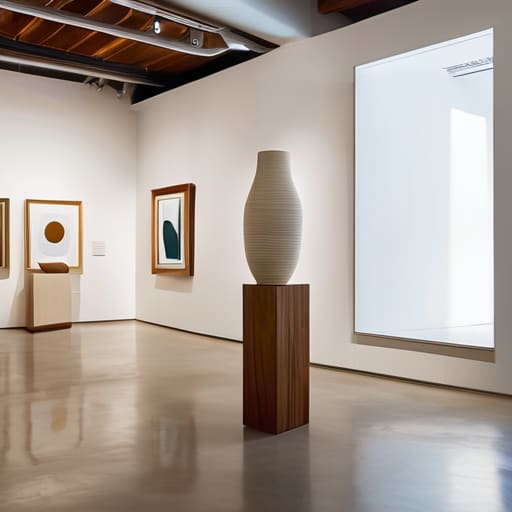
Once you’ve settled on your artists, stop looking at the walls and start looking at the floor. Most people approach gallery space layout as if they are decorating a living room, but you aren’t trying to make a space “cozy”; you are trying to direct a narrative. In a small room, every square inch is high-stakes real estate. If you crowd the walls, the work suffocates; if you leave too much white space, the room feels hollow and amateurish. You need to create a rhythm of sightlines that forces the viewer to move, rather than letting them hover in one corner and call it a day.
When it comes to displaying artwork in small spaces, the biggest mistake is the “salon hang” gone wrong. You might think grouping works together saves space, but in a tight venue, it often just creates visual noise. I always tell my artists: give the work room to breathe, even if it means showing less of it. If you have a large canvas, it needs a moment of solitude to command its price point. Don’t let a mediocre small sketch cannibalize the impact of your centerpiece just because you were worried about empty wall space.
The Myth of the Cohesive Show
Stop trying to curate a collection that looks like a matched set of luggage; a small exhibition isn’t a decorative exercise, it’s a conversation, and if every piece is saying exactly the same thing, you aren’t hosting a show, you’re just filling a room.
Vivienne Ashworth-Pryce
The Final Inventory
At the end of the day, curating a small exhibition isn’t about whether you’ve managed to fill every square inch of wall space; it’s about whether you’ve created a coherent conversation between the pieces. You’ve done the hard work of selecting the right artists, you’ve written a statement that doesn’t hide behind academic jargon, and you’ve wrestled with the physical constraints of a cramped room. Now, you must ensure that your logistical choices—from the lighting to the way you’ve priced the works—actually support the narrative you’ve built. If the layout is a mess or your pricing feels arbitrary, the artistic intent will always be drowned out by the sheer friction of a poorly executed show. Don’t let the mechanics of the exhibition undermine the quality of the work itself.
If you are feeling a bit bruised by the sheer amount of non-art labor this required, take a breath and realize that this is exactly what the professionals do. There is a certain dignity in mastering the “unromantic” side of the trade. When you stop viewing the logistics as a distraction from your creativity and start seeing them as the essential scaffolding that allows your vision to stand upright, you stop being an amateur and start being a professional. Go ahead, open the doors, and let the work speak. You’ve built the stage; now it’s time to let the performance happen.
Frequently Asked Questions
If I'm organizing this myself, how much of my "profit" should I actually be setting aside for the venue's overhead versus the artists' cuts?
Oil on canvas, 40x40cm, 2024. It’s a messy question, but a necessary one. If you’re running this yourself, stop thinking in terms of “profit” and start thinking in terms of “operating budget.” You should aim to cover the venue’s hard costs—rent, insurance, lighting—first. Once those are cleared, I’d suggest a 60/40 split in favor of the artist. If you’re taking 50% but you aren’t providing professional marketing and a climate-controlled space, you’re just a middleman with a hobby.
How do I stop the exhibition from looking like a cluttered student show when I'm working with such limited wall real estate?
Oil on canvas, 40cm x 40cm, 2023. I love the texture, but you’ve crowded it. Listen, the “cluttered student” look happens because you’re trying to show everything you’ve ever made. Stop it. Curating a small space is an exercise in subtraction, not addition. You need breathing room—actual physical gaps between works—to let the viewer’s eye rest. If every inch of wall is covered, nothing is special; it’s just wallpaper. Pick your strongest pieces and let them stand alone.
Once the show is up, what is the actual line between "promoting the work" and just begging my friends to come buy something?
The line is drawn at the value proposition. “Promoting” is telling a collector why this specific series matters to their collection or the current cultural conversation. “Begging” is telling your Aunt June that you need the money for rent. If your outreach is focused on the work’s merit and its place in the market, you’re a professional. If you’re leading with your personal struggle, you’re a hobbyist asking for a handout.
