
I remember sitting in my small gallery office, nursing a lukewarm Earl Grey and staring at a submission from a lovely painter whose work was, frankly, transcendent. But her artist statement? It was a dense, impenetrable thicket of “liminality,” “juxtaposition,” and “interrogating the zeitgeist” that made my eyes glaze over within three sentences. I didn’t need a philosopher; I needed to know why she picked up a brush. Most artists treat this document like a high-stakes academic exam, but if you want to know how artist statements should be written, you have to stop trying to impress people with vocabulary you don’t actually use.
I’m not here to give you a lecture on theory or tell you to hire an expensive consultant to sprinkle some “art speak” over your intentions. Instead, I’m going to tell you how I actually read these things when I’m deciding whether to offer an artist a solo show or a polite rejection. I will show you how to strip away the pretentious fluff and replace it with the kind of clarity that actually moves a collector to open their wallet.
Ditching the Pretension to Find Your Real Artistic Voice and Tone
I have spent decades sitting across from artists who tried to hide behind a wall of academic jargon, hoping that if they used enough polysyllabic words, I wouldn’t notice their work lacked a cohesive concept. It is a common mistake. When you are avoiding art world pretension, you aren’t just making things easier for the reader; you are making it easier for the buyer to connect with the work. If I have to consult a dictionary just to understand why you used cobalt blue instead of ultramarine, I’ve already lost the thread of your intention.
Finding your true artistic voice and tone means learning to speak about your work with the same clarity you would use when explaining a passion project to a friend. This isn’t about stripping away the intellect—far from it—but about stripping away the performance. A collector isn’t looking for a thesis; they are looking for a reason to care. When you stop trying to sound like a museum catalogue and start actually explaining your creative process, you stop being a mystery to be solved and start being an artist to be understood.
Explaining Creative Process Without Losing the Collectors Interest
When you start explaining creative process, there is a massive temptation to wander into the weeds of your studio habits. I’ve sat in a hundred meetings where an artist spent twenty minutes describing the specific chemical composition of their glaze or the exact way they layer charcoal, only to watch the collector’s eyes glaze over. They aren’t buying your technical manual; they are buying the why behind the work. If you spend your entire statement explaining how you move a brush, you’ve missed the point. You need to bridge the gap between your hands and the viewer’s heart without sounding like a chemistry textbook.
The goal is to provide context, not a chore list. Instead of a dry inventory of tools, tell me how your method dictates the emotion of the piece. If you use heavy impasto to convey tension, say that. That is a way of avoiding art world pretension while still giving the buyer a hook to hang their hat on. You want them to feel like they are being let in on a secret, not being lectured by a professor. Keep it focused on the intention, and you’ll find that the process actually adds value to the price tag rather than just adding noise.
The Language of the Sale
An artist statement isn’t a philosophical treatise or a place to hide your insecurities behind a wall of academic jargon; it is a bridge between your studio and a collector’s living room, and if that bridge is built out of nonsense, no one is going to cross it.
Vivienne Ashworth-Pryce
The Bottom Line on Your Words
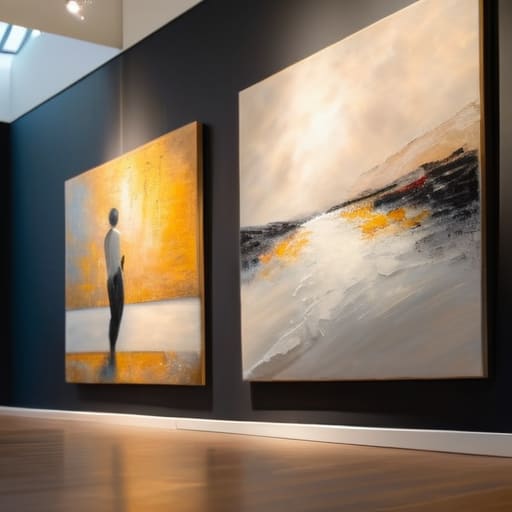
At the end of the day, your artist statement isn’t a thesis for a graduate seminar; it is a bridge between your studio and a collector’s living room. We have covered how to strip away the academic fluff, how to talk about your process without sounding like a manual, and why finding a voice that is actually yours is more important than sounding “important.” If you can manage to be clear about what you do and why you do it, you have already done more than ninety percent of the artists walking through my gallery doors. Remember: clarity is a form of respect for the person holding the checkbook. Don’t make them work harder than they have to just to understand what they are actually buying.
I spent twenty-six years watching people walk away from beautiful work simply because they couldn’t connect with the person behind it. A good statement doesn’t just describe a canvas; it invites someone into your world. It turns a piece of pigment and cloth into a story worth owning. Stop trying to hide behind a curtain of pretension and just tell the truth. The right collectors aren’t looking for a philosopher; they are looking for an artist who knows exactly who they are. Go write something that sounds like a human being, and then get back to the work.
Frequently Asked Questions
How much of my personal biography actually belongs in a statement versus the work itself?
Listen, I’ve seen a thousand statements that read like a Wikipedia entry for a person no one cares about. Unless your childhood trauma in a coastal village is the literal, physical engine driving the brushstrokes on the canvas, leave it out. A collector wants to know why the work exists, not where you went to primary school. Keep the biography to a single, punchy sentence. If the work is good, it should tell the story; the statement just provides the map.
If I’m working in a medium that is purely intuitive or abstract, how do I explain the 'why' without sounding like I'm making it up as I go?
Listen, I’ve seen hundreds of abstract works where the statement reads like a fever dream of “energy” and “vibrations.” It’s exhausting. If your process is intuitive, don’t lie and say you had a blueprint. Instead, talk about the physical constraints or the visual problems you’re solving. Are you exploring the tension between weight and color? The way light hits a specific texture? Talk about the visual logic you’re following, even if that logic is discovered in the moment.
Is there a specific length I should aim for, or am I better off being brief to avoid the risk of rambling?
Brief is better, but don’t mistake brevity for emptiness. If you can say it in two paragraphs, don’t use five. I’ve seen statements that read like a doctoral thesis; collectors aren’t looking for a reason to feel intellectually inadequate, they’re looking for a reason to connect with the work. Aim for a page maximum, but really, aim for clarity. If you start rambling, you aren’t explaining your art—you’re just hiding behind words.
