

Most “complete guides to portrait painting” you’ll find online are written by academics who have never had to look a paying client in the eye or explain why a canvas costs three months’ rent. They’ll drown you in the chemistry of pigments or the geometry of the skull, as if mastering a mathematical formula will suddenly make a collector want to hang your work in their living room. I spent twenty-six years watching talented artists follow these exact blueprints, only to end up with a studio full of technically perfect faces that nobody—and I mean nobody—was actually buying.
I’m not here to teach you how to mix a perfect flesh tone, though we will touch on that. Instead, I am going to give you the unromantic, practical reality of what it takes to make a portrait that functions as a valuable asset. We are going to strip away the pretension and talk about the intersection of technical skill, the psychology of the sitter, and the brutal economics of the market. This is your no-nonsense roadmap to creating work that doesn’t just sit in a studio, but actually moves.
Mastering Facial Anatomy for Artists to Justify Your Premium

Let’s be blunt: a collector isn’t paying a premium for your ability to make a nose look like a nose. They are paying for the sense that the person on the canvas is actually alive. If you treat a face like a flat map of features rather than a complex architectural structure, the work will always feel decorative, never profound. This is where your study of facial anatomy for artists moves from a classroom exercise to a commercial necessity. When you understand the underlying bone structure and how the musculature shifts, you stop guessing and start commanding.
The difference between a hobbyist and a professional often lies in the subtle tension of a jawline or the way light interacts with the orbital bone. If you aren’t mastering specific shading techniques for skin tones to suggest depth and volume, you are essentially leaving money on the table. A buyer can sense when a portrait is merely “correct” versus when it possesses a structural integrity that feels permanent. You don’t need to paint every pore, but you must demonstrate that you understand the weight of the face. That is what justifies the higher price tag.
The Truth About Oil Painting Portrait Methods and Market Value

Oil on canvas, 24×30, 2024. I think it’s a fine piece, but let’s talk about why it actually commands a price.
Most artists treat oil painting portrait methods like a sacred, untouchable ritual, but collectors don’t care about your specific layering process or whether you prefer the Alla Prima approach or a slow, traditional glazing method. They care about the perceived value of the finish. If your work looks like a muddy struggle of unblended pigments, you’re leaving money on the table. You can master the most complex shading techniques for skin tones, but if the surface lacks that professional, intentional luminosity, the buyer will subconsciously flag it as “amateur,” regardless of how much you spent on your pigments.
The market is ruthless about technical cohesion. You can spend years perfecting the minutiae of drawing realistic eyes and lips, but if those details don’t sit within a structurally sound composition, the painting feels “off.” A collector isn’t just buying a likeness; they are buying the confidence of your execution. If your technique looks indecisive, your pricing will remain indecisive too.
The Portraitist’s Financial Fallacy

Oil on canvas, 40x50cm, 2024. It’s a beautiful piece, but don’t mistake a mastery of the zygomatic bone for a business model; a collector isn’t paying you for the anatomy lessons, they are paying for the ability to see themselves—or their legacy—rendered with a confidence that makes the price tag feel like a secondary concern.
Vivienne Ashworth-Pryce
The Bottom Line on the Painted Face
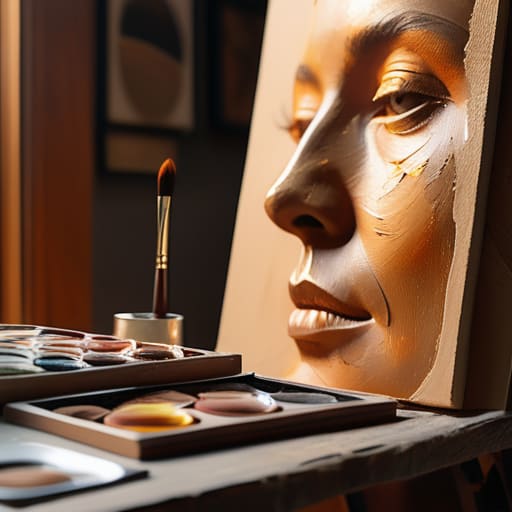
At the end of the day, a successful portraitist needs more than just a steady hand and a deep understanding of the zygomatic bone. We have covered how technical mastery of anatomy justifies your premium and why the specific medium you choose—whether it’s the slow, deliberate build of oils or the immediacy of acrylics—directly dictates the perceived value of the finished piece. If you aren’t connecting your technical decisions to the expectations of a collector, you aren’t just making art; you are making expensive mistakes. You must bridge the gap between the studio and the market by ensuring your skill is visible, your materials are professional, and your pricing reflects the labor of true expertise rather than just the cost of your pigment.
Don’t let the business side of this industry intimidate you into mediocrity. The world will always have room for a portraitist who can capture more than just a likeness, but who can also command the respect of the room through professionalism and precision. I spent twenty-six years looking at thousands of faces on canvas, and the ones that stayed with me—the ones that collectors fought over—were never just about “correct” proportions. They were about the artist’s ability to marry technical authority with a soul. Go back to your easel, refine your craft, but for heaven’s sake, know your worth before you ever pick up the brush.
Frequently Asked Questions
If I’ve mastered the anatomy and the medium, why am I still struggling to find collectors who actually want to commission a portrait?
Because you’re selling a likeness when you should be selling an experience. Most artists think a commission is a technical transaction—”I draw your nose, you pay me.” It isn’t. Collectors don’t want a high-fidelity photocopy; they want to feel something about the person in the frame. If your marketing focuses on your anatomical precision rather than the emotional legacy of the piece, you’re just a technician. And technicians are a dime a dozen.
How do I decide whether to price my portraits based on the hours I spend on them or the perceived value of the subject?
If you price by the hour, you are essentially punishing yourself for getting better. The moment you master a technique that allows you to capture a likeness in ten hours instead of fifty, you’ve effectively taken a pay cut. Price based on the value of the result. A collector isn’t paying for your labor; they are paying for the heirloom. If the subject is a CEO or a beloved matriarch, price for the importance of the moment, not the clock.
At what point does a portrait stop being a "study" and become a high-value piece of fine art that a gallery would actually bother representing?
Oil on canvas, 24×30, 2024. I like it, but let’s be honest about why it matters. A study is a private conversation between you and the subject; it’s an investigation of light or bone structure. A fine art piece is a public statement. A gallery represents work that possesses a finished intentionality—where the technical mastery of the anatomy serves a cohesive vision rather than just proving you can draw an eye.
